

A practical starting guide
ChatGPT for business owners. Start with one useful task.
You don’t need to learn everything about AI. Start with a piece of work you understand well enough to judge: an email, a meeting recap or a short business update.
Try a real lesson. No signup.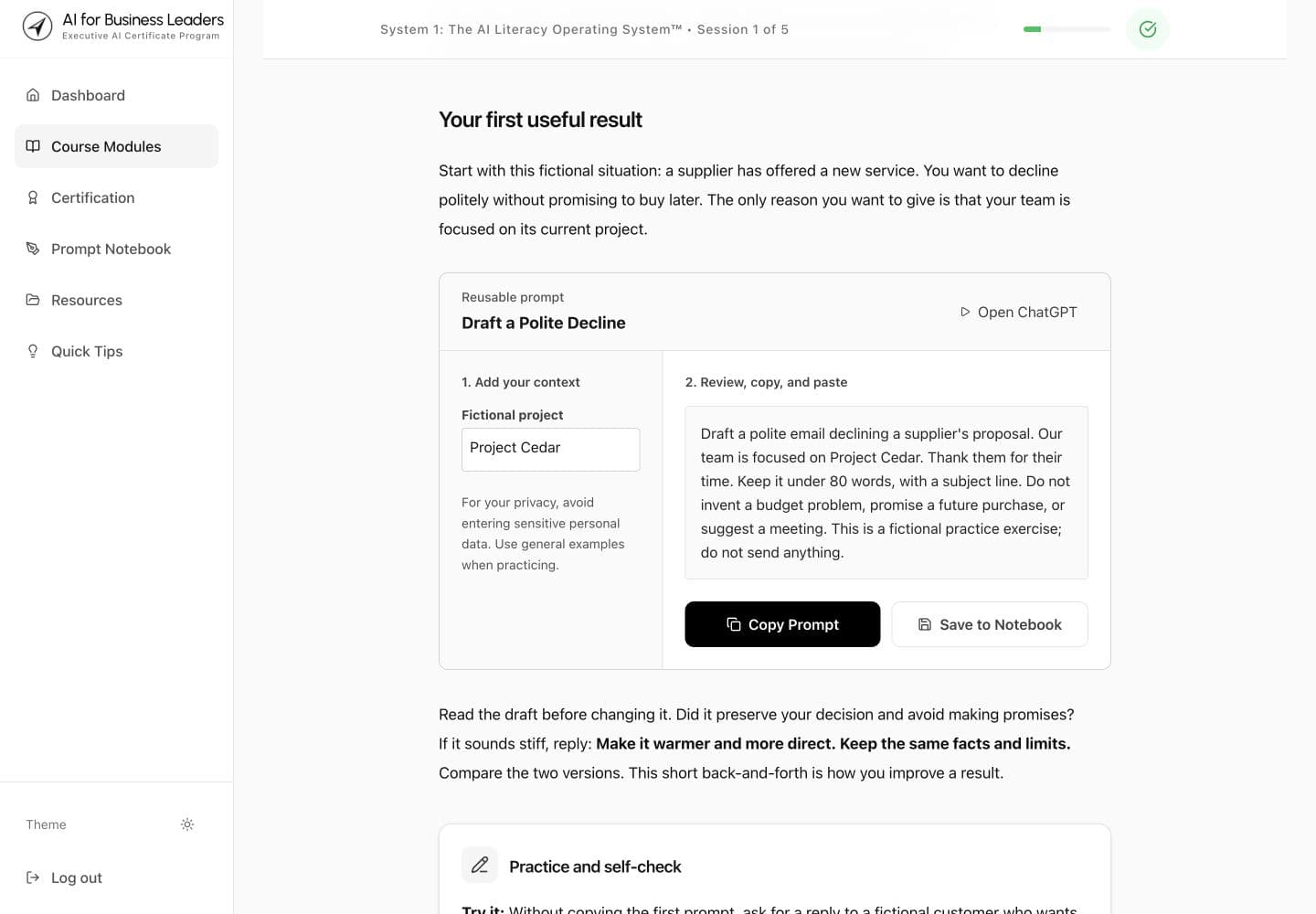
By Corsa Courses · Updated
Use your judgment. Let it help with the draft.
ChatGPT can turn rough notes into a draft, suggest another way to explain something, or organize information you provide. It can also misunderstand you and invent details. Treat its answer as work to review, not an instruction to follow.
A useful first task is a routine customer email. Avoid starting with payroll, a confidential contract or a decision that affects someone’s health or employment.
Give it the assignment you would give a colleague.
Say who the message is for, what happened, what the reader needs to know and how you want it to sound. For practice, use made-up details:
Try a customer email
Draft a short email to a customer. Their order will arrive on Thursday instead of Tuesday. Apologize plainly, explain the new date and invite them to reply with questions. Use a calm, professional tone. Do not invent a reason for the delay or offer a discount.
Uses fictional information. Your answer may differ from the example.
Then ask for a specific improvement: “Make the opening less formal and keep it under 90 words.” You do not need to start a new conversation for each revision.
Check these three things before sending.
- 1. The facts. Are the dates, names, amounts and promises correct? Remove anything you did not supply or cannot verify.
- 2. The judgment. Is this the right message for this customer? Does it commit your business to something you did not intend?
- 3. The voice. Would you actually say it this way? Keep the useful wording and change the rest.
Before entering real business information, follow your organization’s data policy. Use placeholders for customer details and leave out passwords, payment information and confidential material.
Three other places to start.
Choose work you can check. Use fictional or non-confidential notes for your first attempt.
- Turn meeting notes into next steps
- Ask for a short list of decisions, owners and deadlines. Tell it to mark missing details as “not specified.” Check that a suggestion has not become a decision.
- Try the meeting-notes example
- Compare two supplier proposals
- Provide a made-up summary of price, scope and delivery dates. Ask for differences and questions to resolve, not a purchasing decision. Check every number against your notes.
- Try the supplier comparison
- Write a procedure from rough notes
- Describe a routine task you know well. Ask for numbered steps using only those notes. Have the person who does the task check the order and any missing steps.
Choose training that includes practice, not just a list of tools.
Look for worked examples, time to try them and a clear way to check your work. A certificate should tell you who issues it and what you must do to earn it. It does not replace practical ability.
Our course follows that pattern across 8 modules and 62 written lessons. You practice communication, analysis, repeatable workflows and responsible use. No programming or live attendance is required.
The course costs $497 once. ChatGPT is a separate service. The Corsa Courses certificate requires completing the lessons and passing the assessment; it is not an OpenAI or university qualification.
Choose your next step.
A business decision
Compare supplier quotes
Put the costs on the same footing before choosing.
An everyday task
Turn meeting notes into action
Keep decisions, suggestions and next steps separate.
Your credential
Understand the certificate
What you earn, how you earn it and how it is verified.
Before you enroll
Choose an AI course
Compare the kind of learning you actually need.